Japan Launch Event – Seizing the Moment of Opportunity: Japanese Translation of the UN Technical Report
On 22 July 2025, the United Nations released a special technical report in which Secretary-General António Guterres declared that the world is on the cusp of a new era, having reached a point of no return in the global transition away from fossil fuels. This shift has been driven by the sharp decline in renewable energy costs and the rapid deployment of renewables over the decade since the adoption of the Paris Agreement.
Renewable Energy Institute has translated the UN report “Seizing the Moment of Opportunity: Supercharging the New Energy Era of Renewables, Efficiency, and Electrification” into Japanese. In collaboration with the Japan Climate Initiative, the Institute hosted a symposium to present the content of the report’s key findings and explore how Japan can seize this opportunity for transformation.
Opening Sergio Shigeo Kato, Co-Representative, Japan Climate Initiative (JCI)
Message from the United Nations Selwin Hart, Special Adviser to the UN Secretary-General on Climate Action and Just Transition Kaoru Nemoto, Director, United Nations Information Centre (UNIC) Tokyo
Presentation 1: Key Insights from the UN Report “Seizing the moment of opportunity” Karolin Jiptner, Senior Researcher, Renewable Energy Institute DL
Presentation 2: Japan’s Challenges and Opportunities in the Energy Transition Yukari Takamura, Professor, Institute for Future Initiatives, The University of Tokyo DL
Video: Presentation 1 and 2
Panel Discussion: How to Seize Opportunities for Renewable Energy in Japan
–Takeaki Masukawa, Director General, Japan Photovoltaic Energy Association (JPEA) DL
–Akiko Miura, Senior Director for Environmental Policies, Bureau of Environment, Tokyo Metropolitan Government DL
–Kahori Miyake, Fellow, Sumitomo Mitsui Trust Bank / Executive Managing Director, Japan Climate Leaders’ Partnership (JCLP)
–Hiroshi Takahashi, Professor, Department of Policy Science on Society, Faculty of Social Sciences, Hosei University DL
Moderator: Kae Takase, Senior Manager, Climate Change, Renewable Energy Institute DL
Closing: Teruyuki Ohno, Executive Director, Renewable Energy Institute
Video: Panel Discussion and Closing
*Networking will follow after the program (reception style).
Speakers Profile (Updated as needed. Titles omitted. In program order.)
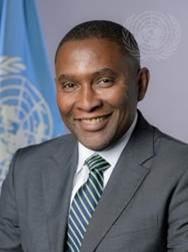
Selwin Hart, Special Adviser to the UN Secretary-General on Climate Action and Just Transition / Assistant Secretary-General of the Climate Action Team
The Special Adviser ensures delivery of the Secretary-General’s priorities on climate change. Prior to his appointment, Selwin Hart served as the Executive Director for the Caribbean region at the Inter-American Development Bank (IADB). From 2016 to 2018, he was the Ambassador to the United States and Permanent Representative to the Organization of American States for Barbados. Before that, he was Director of Secretary-General Ban-Ki Moon’s Climate Change Support Team, leading delivery of the 2014 Climate Summit and the Secretary-General’s engagements on climate leading to the adoption and the signing of the Paris Agreement.
Throughout his career, he has served in several climate action leadership positions, including as a Climate Adviser for the Caribbean Development Bank, Chief Climate Change Negotiator for Barbados, as well as the Coordinator and Lead Negotiator on Finance for the Alliance of Small Island Developing States, a coalition of 43 islands and low-lying coastal States in the Caribbean, Pacific, Africa, Indian Ocean and South China Sea. He was a member of the Kyoto Protocol Adaptation Fund Board from 2009 to 2010 and was elected by the United Nations General Assembly to serve as Vice-Chair of the Second Committee of the United Nations General Assembly (Economic and Financial) during its sixtieth Session.
He holds a bachelor’s degree from the University of the West Indies and master’s degree from Fordham University.
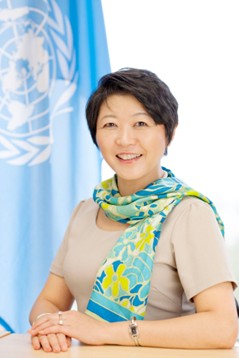
Kaoru Nemoto, Director, United Nations Information Centre (UNIC) Tokyo
After working as a TV Asahi announcer and reporter, Nemoto joined UNHCR (United Nations High Commissioner for Refugees) in 1996. In her career at UNHCR till end 2011, she was active in the field to assist and protect refugees as well as in developing policies and managing fund-raising from the private sector at the Geneva headquarters. Nemoto also worked as spokeswoman for WFP (World Food Program) and Executive Director at Japan Association for UNHCR. She assumed her current position in August 2013. From September 2016 through June 2024, she was a member of the Sustainable Development Goals (SDGs) Promotion Roundtable, established by the Japanese Government. She received the “Person of the Year Award” of the Public Relations Society of Japan for the year 2021, praised for her work on promoting UN activities and the importance of SDGs. She earned Law degree from University of Tokyo and Master’s degree in International Relations from Columbia University.
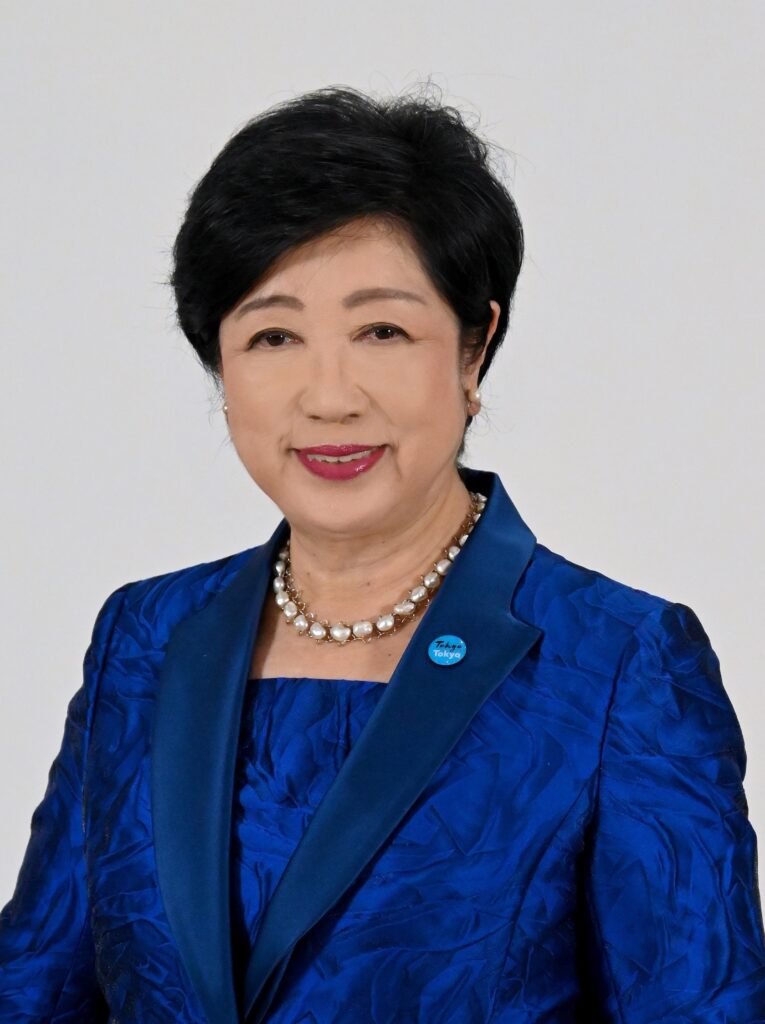
Yuriko Koike, Governor of Tokyo
Yuriko Koike has been the Governor of Tokyo since 2016. In July 2024, she was re-elected to her third term of office.
Prior to being elected to the post, she was active in national politics. She held several cabinet posts, including minister of the environment and minister of defence. As environment minister, she introduced the Cool Biz campaign to encourage workers to wear light and comfortable attire during the summer months.
As governor, to achieve a Zero Emission Tokyo by 2050, she announced in January 2021 that Tokyo has set the Carbon Half goal of reducing greenhouse gas emissions by 50% by 2030.
This was followed by a kickoff meeting in February and TIME TO ACT FORUM every year to roll out a global movement for climate action under the slogan “Time to Act”. Moreover, in March this year, she has developed the “Zero Emission Tokyo Strategy: Beyond Carbon Half” to further accelerate its efforts towards Carbon Half by 2030 and beyond, introducing a new target of reducing greenhouse gas emissions by more than 60% by 2035.
Yukari Takamura, Professor, Institute for Future Initiatives, The University of Tokyo
After receiving Master of Laws (Public International Law) from Hitotsubashi University, Tokyo, she was appointed Associate Professor at Shizuoka University. Before joining the University of Tokyo in 2018, she worked as Professor at Ryukoku University, Kyoto, and Professor at Nagoya University, Japan. She also studied at Graduate School of University of Paris II (Panthéon-Assas), France and was Visiting Researcher at University of London, U.K.
She is member of the Editorial Board of Journal Sustainability Science and of the Editorial Advisory Board of Journal Climate Policy. She is member of Board of Directors of the Japanese Society for Environmental Economics and Policy Studies as well as member of the Board of Executive Directors of the Japanese Society for Environmental Law and Policy Studies.
She serves as member of governmental advisory bodies, among others, Central Environmental Council as President, and Procurement Price Calculation Committee for Feed-in Tariff Scheme for Renewable Energy as Chair. She is also member of the Advisory Group on Climate Change and Sustainable Development of the Asian Development Bank (ADB). She is member of Science Council of Japan and serves as Vice President since October 2020, and received Environmental Conservation Merit’s Minister of the Environment Award in 2018.
Hiroshi Takahashi, Professor, Department of Policy Science on Society, Faculty of Social Sciences, Hosei University
Hiroshi Takahashi specializes in public policy and energy policy. He obtained a master’s degree from the Fletcher School of Law and Diplomacy, MA, USA and a doctoral degree from the University of Tokyo, and currently serves as Professor at the Faculty of Social Sciences at Hosei University. His former career includes Deputy Director at IT Policy Office of Cabinet Secretariat, Assistant Professor at the University of Tokyo, and Research Fellow at Fujitsu Research Institute, and Professor at Tsuru University. He has actively participated in the policy formation of Japan’s electricity system reform and renewable energy policy as a member of the Advisory Committee for Natural Resources and Energy, a special advisor to the Cabinet Office and a member of Regulatory Reform for renewable energy deployment. He is the author of “International Political Economy of Energy Transition” (2021, Nihon Hyoron Sha), “Energy Policy Studies” (2017, Iwanami Shoten) and “Market Liberalization of Electric Utilities” (2011, Nihon Keizai Shimbun Shuppansha), among others.
Takeaki Masukawa, Secretary General, Japan Photovoltaic Energy Association (JPEA)
Takeaki Masukawa joined Showa Shell Sekiyu in 1985 and after two years of training in oil refinery, he spent 11 years in the oil and gas exploration business, which involved acquiring mining rights and oil field acquisitions. During this time, he worked in an operating company of Shell in the Netherlands for four years. From 2002, he was appointed as manager of distributed power generation business and power retail sales, gaining experience in the electric power business industry. In 2007, he joined the corporate planning division and assisted in establishing a company that provides charging services for electric vehicles. In 2013, he was seconded to Solar Frontier and contributed to the development of the Japanese solar industry’s vision. He assumed the role of Secretary General of JPEA for two years from June 2017 and has resumed the same position since January 2023.
Akiko Miura, Senior Director for Environmental Policies, Bureau of Environment, Tokyo Metropolitan Government
Akiko Miura joined the Tokyo Metropolitan Government (TMG) in 1994. From 2014, as Director of the Bureau of Environment, she set goals and formulated policies related to the expansion of renewable energy at TMG and planned and operated the Tokyo Cap-and-Trade Program. From 2022, as Senior Director for Planning and Senior Director for Environmental Policies, she was responsible for the comprehensive planning, research, coordination, and promotion of environmental policies. In March 2025, she formulated and published the Zero Emission Tokyo Strategy Beyond Carbon Half, which summarizes 2035 targets and policies toward realizing a 2050 Zero Emission Tokyo.
Kahori Miyake, Fellow, Sumitomo Mitsui Trust Bank / Executive Managing Director, Japan Climate Leaders’ Partnership (JCLP)
Ms. Miyake is a Fellow at Sustainability Strategy and Solutions Department at Sumitomo Mitsui Trust Bank and Executive Managing Director of Japan Climate Leaders’ Partnership (JCLP), a coalition of over 230 businesses advancing decarbonization in the country. She has been heavily involved in lobbying activities not only to the government and policy makers since taking the role in JCLP, but also to various industry players and also to the public. In 2022, she served as a member of High-Level Expert Group on the Net-Zero Emissions Commitments of Non-State Entities convened by Secretary General Guterres. Prior to the current role, Ms. Miyake served as the Chief Sustainability Officer of Aeon Co. Ltd., a retail conglomerate in Japan.
Sergio Shigeo Kato, Co-representative, Japan Climate Initiative (JCI)
After assuming several senior executive positions in Europe and Japan at Ricoh, Sergio Shigeo Kato was appointed General Manager of the Sustainability Management Division in 2015, where he was responsible for developing Ricoh Group‘s decarbonization declaration, driving Ricoh to become the first company in Japan to join RE100, and integrate SDGs values into business, leading the company to adopt ESG-oriented management. Since then, he has collaborated with companies across industries in Japan to resolve social issues related to climate change. He held roles as Co-Chair of the Japan Climate Leaders’ Partnership (JCLP), Board Member of the World Environment Center (WEC) and Board Member of Global Compact Network Japan (GCNJ). He also served as a member of the Advisory Panel of Experts on Climate Change established by the Ministry of Foreign Affairs of Japan. Together with Takejiro Sueyoshi, he advocated for creating a network of non-state actors in Japan, and contributed to the establishment of Japan Climate Initiative (JCI) in July 2018.
Teruyuki Ohno, Executive Director, Renewable Energy Institute
Teruyuki Ohno joined Renewable Energy Institute in 2013. He has actively participated in the policy formation of Japan’s climate change measures as a member of national and local governments’ committees. Before joining the Institute, he was Director General of the Bureau of Environment, Tokyo Metropolitan Government from 2010 to 2013, covering a broad range of environmental issues including energy, climate change, waste management, pollution control, natural environment, and sustainable development. His notable achievements include the “No Dirty Diesel Vehicle Strategy in Tokyo” which reduced the air pollution and PM emissions, and the implementation of Japan’s first Cap-and-Trade Program in Tokyo in 2008, involving the industries and successfully building a grand consensus. His active leadership in promoting renewable energy and energy efficiency led to the formation of the foundation of Tokyo’s energy policy. From 2021 to 2024, he served as Special Advisor to the Tokyo Metropolitan Government. He is also a Board Member of WWF Japan. He received the Haagen-Smit Clean Air Award from the California Air Resources Board in 2014. His publications include “Energy Strategies of Municipality Governments” (Iwanami, 2013, Japanese) among others.
Kae Takase, Senior Manager, Climate Change, Renewable Energy Institute
Kae Takase joined Renewable Energy Institute in 2023. Previously she was Associate Director at CDP Worldwide-Japan, where she was responsible for helping Japanese companies and investors to set science-based targets (SBT), procure renewable electricity (RE100), and disclose TCFD-aligned sustainability information. She worked as a modelling analyst at the Institute of Energy Economics, Japan, the Research Institute of Innovative Technology for the Earth, and Center for Low Carbon Society Strategy under the Japan Science and Technology Agency, built and ran Integrated Assessment Model for Climate Change, Computable General Equilibrium Model, Econometric Model, Energy System Model, bottom-up model for the energy system. She also initiated and conducted pilot projects for ‘Pay as You Save’ scheme for solar power and other energy efficiency improvement measures in several municipalities.
She graduated from Keio University (B.A., M.A.) and the University of Tokyo (PhD). She has also spent a year in Yongin University in South Korea to devote herself to taekwondo and take a break from research.
Karolin Jiptner, Senior Researcher, Renewable Energy Institute
Karolin Jiptner joined Renewable Energy Institute in April 2025. She specializes in international climate policy and the acceleration of climate action. Previously, she worked at Nagoya University’s Research Center for Net Zero Carbon Society, focusing on individual climate action, carbon footprinting, and environmental education. Until 2023, she worked at the International Center of Yamagata University, where she was involved in education and international affairs. Alongside this role, she actively conducted workshops and public presentations on climate awareness, climate action, and the SDGs. With a Ph.D. in engineering from Tsukuba University in 2013, Karolin Jiptner has experience in research, education, and policy advisory roles, including participation in Yamagata Prefecture’s green energy committees.
At Renewable Energy Institute, her research focuses on policies driving global carbon neutrality efforts, particularly in Europe (with a focus on Germany) and Southeast Asia.
Event Details
◇Date / Time Friday 3 October / 15:30-17:30
*Networking will follow after the program (reception style)
◇Venue Tokyo International Forum, Hall D7
◇Co-organized by Japan Climate Initiative (JCI), Renewable Energy Institute
◇Supported by United Nations Information Centre (UNIC) Tokyo