

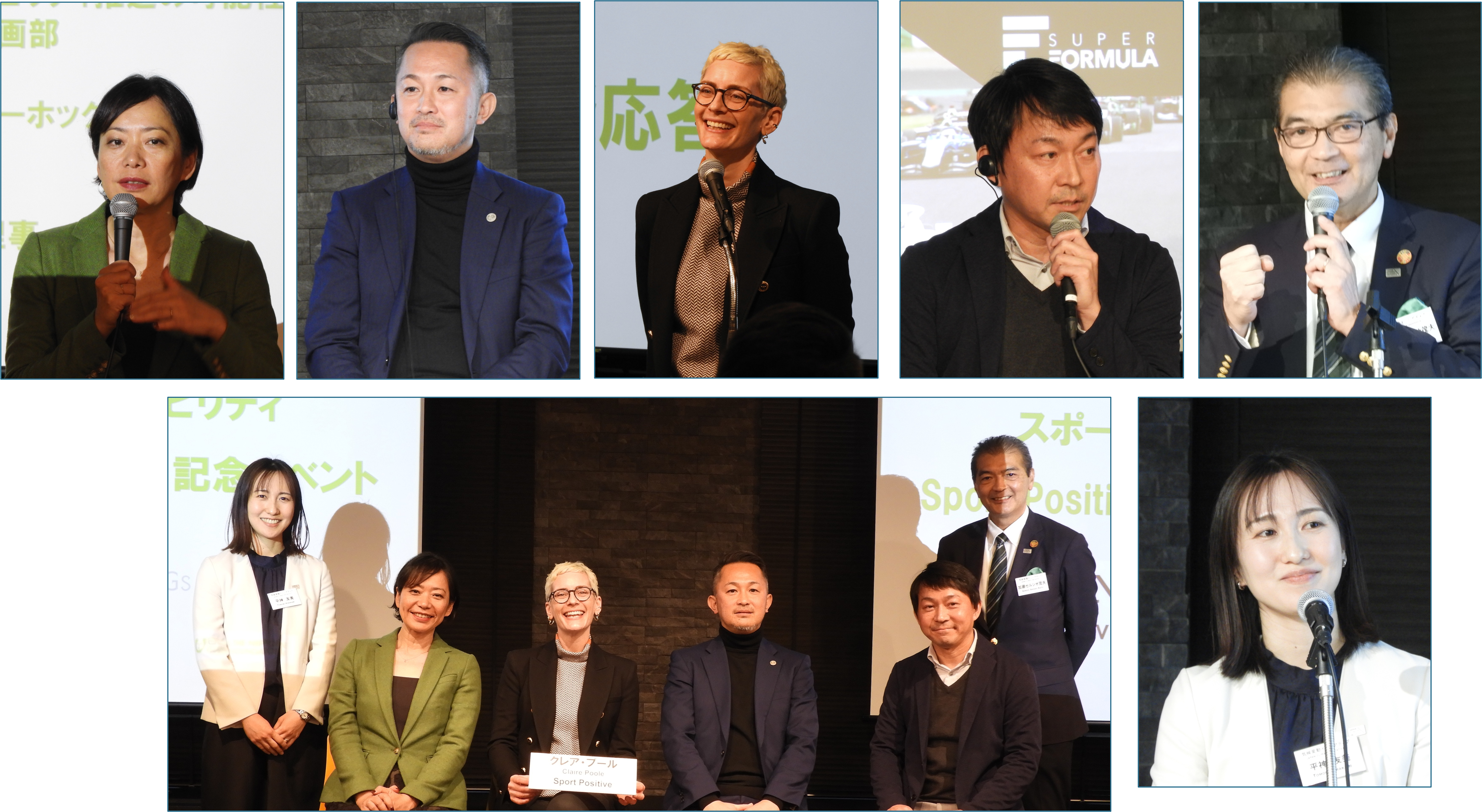
The Japan Climate Initiative (JCI) co-hosted an event on sport and sustainability together with the SDGs in Sports, to coincide with the visit to Japan of Claire Poole, Founder and CEO of Sport Positive.
In recent years, sport has expanded its role beyond competition and entertainment to become a powerful platform that connects companies, local governments, and communities to address social challenges while creating business value. In Europe and North America in particular, leagues and clubs are increasingly integrating sustainability into their management strategies, brand value, sponsorship models, and community engagement. These efforts are enhancing the competitiveness of the sports business while harnessing the influence of sport to accelerate climate action.
At this event, Claire Poole, CEO of Sport Positive—an international initiative driving this global momentum—shared the latest international trends in sustainability within the sports sector, along with concrete examples of leading initiatives from around the world.
The event also featured a panel discussion with Hiroshi Kitora (Honda Mobilityland Corporation / Suzuka Circuit) and Gengo Seta (Mito HollyHock), focusing on sustainable initiatives driven by sport. Practical examples from Japan were presented, including Suzuka Circuit’s efforts toward achieving net zero by 2030 and Mito HollyHock’s agrivoltaics initiative, which combines agricultural production with solar power generation on underutilized farmland to address both regional and climate-related challenges. These discussions highlighted the potential of sport to generate positive impacts on society and local communities.
■Date & Time: Tuesday, January 27, 2026, 3:00–5:00 PM JST
■Options to participate (limited to JCI members and invited guests):
Onsite: Hibiya International Building Conference Square, 8F Room 8C
Online: Zoom webinar
■Participation Fee: Free (advance registration required – registration closed)
■Co-hosts: Japan Climate Initiative (JCI) and SDGs in Sports
■Language: Simultaneous interpretation (Japanese–English)
■Program
Opening Remarks Video
Naoko Imoto – Executive Director, SDGs in Sports
Keynote Speech: “The Sports Climate Action Framework and Global Trends Video
Claire Poole – Founder & Chief Executive Officer, Sport Positive Slides (English/Japanese)
Panel Discussion Video
・Claire Poole – Founder & Chief Executive Officer, Sport Positive
・Hiroshi Kitora – Secretary General, Sustainability Committee, Corporate Planning
Department, Honda Mobilityland Corporation (Suzuka Circuit / Formula 1
Japanese Grand Prix) Slides (Japanese)
・Gengo Seta – Executive Officer / Deputy General Manager / Head of Business
Division, Football Club Mito HollyHock Co., Ltd. Slides (Japanese)
・Naoko Imoto – Executive Director, SDGs in Sports
Closing Remarks Video
Sergio Shigeo Kato – Co-Representative, Japan Climate Initiative
About Sport Positive and Claire Poole
Sport Positive is an international platform that promotes environmental sustainability through sport, providing practical frameworks that enable sports organizations and companies to take meaningful action.
At its core is the Sport Positive League, a global benchmarking initiative that evaluates and visualizes the environmental performance of leading sports leagues and clubs worldwide. It assesses efforts across multiple dimensions, including climate action, energy and resource management, governance and transparency, and social impact. By making sustainability efforts visible, the League fosters both competition and collaboration, encouraging continuous improvement and behavioral change.
The J.League has become the first sports league in Asia to join the Sport Positive League, with all 60 clubs participating in a league-wide initiative starting from the upcoming season in February.
Claire Poole, Founder and CEO of Sport Positive, is an internationally recognized expert in sport and sustainability. With over 20 years of experience, she has worked with the United Nations, UEFA, international sporting events, professional leagues, and global companies. She has played a leading role in developing practical frameworks that leverage the power of sport to address environmental and social challenges while enhancing corporate value and public trust.
Reference Links
Sport Positive Official Website: https://www.sportpositive.org
Related Article (Forbes): https://www.forbes.com/sites/clairepoolesp/2025/12/01/climate-breakdown-is-destabilizing-the-global-sports-industry/?streamIndex=0
About Honda Mobilityland Corporation (Suzuka Circuit)
Suzuka Circuit is working toward achieving carbon neutrality by 2030, while preserving the appeal of motorsports and creating a new model for sustainable sports events. At the 2025 Formula 1 Japanese Grand Prix, the circuit welcomed a total of 266,000 spectators over three days and gained attention as an environmentally conscious event.
In 2023, Suzuka Circuit earned two stars in the FIA Environmental Accreditation Programme after being assessed across 17 criteria. Following continued improvements in its environmental management systems, the circuit achieved the highest three-star certification in 2024. It was also nominated as a finalist in the Transformation category of the Sport Positive Awards 2025, becoming the first Japanese organization to receive this recognition.
Mito HollyHock launched a GX (Green Transformation) project utilizing agrivoltaics to address both local and global challenges—namely, the increase in abandoned farmland in Ibaraki Prefecture and broader issues such as climate change.
Through this project, abandoned farmland is restored and repurposed to create new value. The electricity generated is sold to two roadside stations (Michi-no-Eki) in Shirosato Town, while agricultural products grown on the site are sold to fans and supporters at home matches. This integrated approach supports the creation of a regional circular and symbiotic economy.
The project also aims to obtain Organic JAS certification, cultivating crops without chemical fertilizers. This farming method itself contributes to climate action by reducing CO₂ emissions.
Project Introduction Video (Japanese)
